
Pushmataha Parole and Probation
Oklahoma assigns related tasks to different authorities. The Oklahoma Pardon and Parole Board docket and results system records Board consideration and action. The Oklahoma Department of Corrections, or ODOC, supervises parolees and many probationers through Probation and Parole Services. A Pushmataha County judge creates probation through the judgment and sentence. None of those entries is the Pushmataha County Jail's physical release time. That local event is recorded by the sheriff, while the court and state systems show why a person is outside custody and whether conditions continue.
Parole is conditional release from state imprisonment for the rest of a sentence. It may be revoked. Probation is court-ordered supervision, often tied to a suspended sentence, and does not require a prior prison term. A deferred sentence is also distinct. The court delays a final conviction while conditions are served, and successful completion may lead to dismissal. Discharge means the state sentence and its supervision have ended. These labels should not be swapped because each directs a Pushmataha County search to a different record keeper.
| Record type | Who creates it | Best confirmation |
|---|---|---|
| Parole | Pardon and Parole Board action, then ODOC supervision | Board result, ODOC status, and the assigned P&P office |
| Probation | Pushmataha County court judgment | Certified judgment and ODOC supervision route when applicable |
| Deferred sentence | Pushmataha County court order | Docket, later dismissal, or certified disposition |
| Discharge | ODOC after jurisdiction ends | Completed status or discharge record from Closed Records |
- Parole
- Conditional release from prison while part of the sentence remains.
- Probation
- Supervision imposed by a court instead of, or after, a custodial term.
- Absconder
- A supervised person reported as having stopped lawful contact, not a person who completed discharge.
- Discharge
- The documented end of ODOC custody and supervision on that sentence.
Verify Pushmataha Post-Release Supervision
Start with the authority that could have imposed supervision. For parole, a Board result can show the action, parole eligibility date, projected release date, stipulations, or detainer wording. A favorable vote is not the jail gate time. Check ODOC next for the actual status. For probation, search the Pushmataha County case in OSCN or ODCR, then read the judgment instead of inferring probation because a name is absent from jail. OSCN warns that its online report is not the official court record, so obtain a certified judgment when the exact terms matter.
Identity comes first. Name-only matches can join the wrong person to a case. Compare a birth date, ODOC number, case number, conviction county, image, and sentence rows where each source provides them. State records do not cover every county-only booking. In the other direction, the sheriff's release entry does not prove that ODOC supervision ended. The Pushmataha County released-inmate search and record path covers that separate custody event.
OK VINE can add a custody-event check for the same person, but it must be read within its scope. A release or out-of-custody event means the reporting agency ended that custody episode. It does not show that parole or probation ended. VINE also does not provide parole-hearing notice, which belongs to the Board's separate victim-notification process. When a Board result, ODOC status, court docket, and VINE event seem to conflict, compare their dates and agencies before drawing a conclusion.
- Determine whether the claimed supervision is parole, probation, or a deferred sentence. Use the court case and known custody history.
- For parole, search the Board's published results by name or ODOC number. Read the Board Action and any detainer language exactly.
- Search the ODOC offender lookup. Compare identifiers and record the displayed status without converting a missing facility into discharge.
- For probation, read the Pushmataha judgment and sentence. Look for suspended or deferred terms, revocation, acceleration, completion, or dismissal.
- Use the Antlers P&P office to route an established ODOC supervision question. Ask for public navigation, not private schedules or case plans.
- When the public view is incomplete, request the existing record from the court, ODOC Closed Records, or the office that created the event.
Note: A Board action may authorize parole before ODOC completes release processing or transfers the person to another authority.
Antlers Pushmataha Supervision Office
ODOC's directory expressly lists an Antlers Probation and Parole Office serving Pushmataha County. That concrete local route matters when the state screen and a fresh release do not yet line up. ODOC policy says the active field record ordinarily moves to the appropriate P&P office within five working days after release to parole or probation. A brief transition gap may therefore be administrative. It is not sound proof that the person absconded, completed supervision, or was never assigned.
ODOC Antlers Probation and Parole Office
202 SW 4th Street
Antlers, OK 74523
580-298-6059
Serves Pushmataha County; confirm current operation before travel.
The official ODOC Probation and Parole directory is the source for this office. Its page also has an “Inactive Counties” heading in a separate community-sentencing or sub-office context. That heading does not cancel the separately listed Antlers office. Staff can route a valid supervision question, but public access does not extend to a person's private address, reporting schedule, treatment details, or case-management notes.
The ODOC directory image below shows the official office resource used for Pushmataha County supervision navigation.
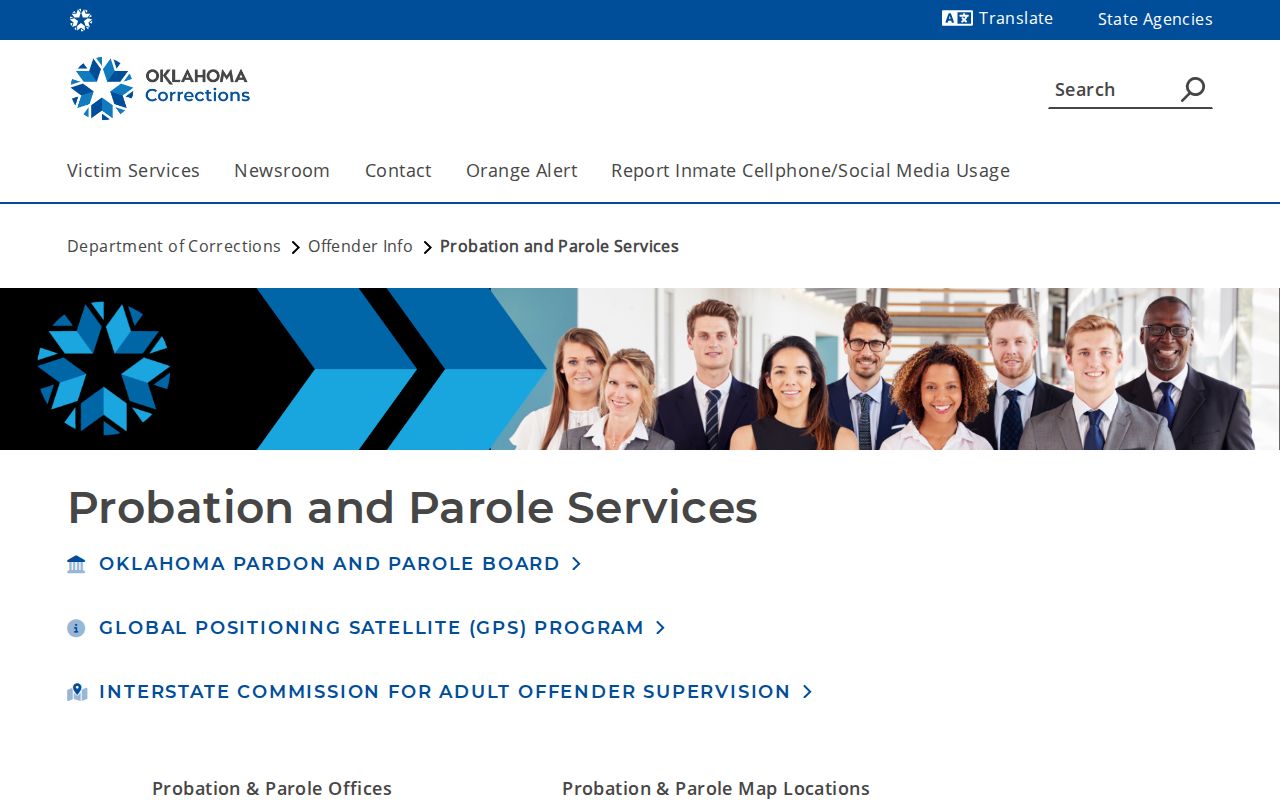
Use the live directory before a visit because an archived image cannot confirm a later phone, address, or office-status change.
Pushmataha Supervision and Absconders
Conditions come from the controlling order and the supervision record. At a high level, they may require reporting and compliance with the terms set by the court, Board, and ODOC. The public court docket can show a filed revocation or acceleration action. It may not show each field contact or private condition. VINE can report certain custody events such as transfer, release, escape, apprehension, or death, but it does not replace the Board's parole-hearing notification program and does not prove that supervision has ended.
An absconder is someone ODOC reports as outside required supervision contact. That is not an ordinary discharge. ODOC supplies an All Fugitives search and lists its Fugitive Warrants Division at 405-425-2570 or 405-425-2571, toll-free 866-363-1119, and warrants@doc.ok.gov. Never approach a listed fugitive. Follow the agency's safety direction. A name on a wanted-person source also should not be treated as a mere data lag.
Pushmataha Supervision Records and Discharge
Supervision ends through an official termination or discharge, not through silence in a search screen. ODOC policy keeps an active field file until custody or supervision ends. The file is then digitized and routed to Closed Records, while inactive ODOC records are retained indefinitely. A discharged state record may therefore call for ODOC Closed Records at 405-425-2691 or the discharge address, osordischarges@doc.ok.gov. ODOC policy lists ordinary copies at $0.25 per page, though the scope and any other charge must be confirmed for the request.
Deferred probation files follow another lifecycle. Research states they are generally retained until 60 days after the deferred period and then destroyed unless acceleration is pending. The county court record remains central to the final result. A successful deferred term may lead to dismissal, but dismissal does not itself prove that every public record has been sealed. Oklahoma's expungement process requires the applicable eligibility basis, petition, notice, hearing, and order.
For material that is not public, ODOC has a signed authorization form for specified incarceration or supervision records. The form normally expires twelve months after signature unless it is revoked sooner, and it does not erase other legal limits. A public lookup needs no such authorization. Choose the narrowest route that fits the fact being checked: court for the judgment, ODOC for state status, P&P for supervision navigation, and Closed Records for an old state file.
Note: Ask for the completed discharge record when possible; an old projected date does not prove that supervision actually ended.
Pushmataha Reentry Through Choctaw Nation
Choctaw Nation Reintegration is a locally relevant route for eligible adult Choctaw tribal members convicted of felonies. Access is subject to prescreening. The program describes case management, referrals, treatment planning, mental-health consultation or referral, and emergency clothing or food aid. It can be reached through the official service page or at 800-522-6170. This is practical reentry navigation, not proof that a person is on parole, probation, or discharged.
Use the program alongside the authority that owns the supervision record. The Antlers P&P office handles ODOC supervision navigation, while a Pushmataha court judgment defines a county probation term. Reintegration staff do not replace either record keeper. Keeping those roles apart helps a person seek support without mistaking service eligibility for a change in legal status.
Pushmataha ID Steps After Release
ODOC policy adds a useful release detail for people leaving its system. Original identity documents held in the record, such as a birth certificate, Social Security card, state ID or license, passport, and military or tribal ID, are to be returned in the discharge and reentry envelope. That rule concerns ODOC releases. It does not establish that the Pushmataha County Jail holds or issues the same papers.
For eligible licensing and ID services, Service Oklahoma documents an Antlers location at 1601 W Main. Check current service requirements and document rules before going. A lost ID issue does not alter parole or probation status, but prompt access to the right document channel can make required travel and service contact easier after release.
Note: Confirm which agency held the documents before seeking replacements; county jail practice and ODOC discharge policy are not the same.